
The first query that arises in response to this question is whether Israel can be considered an actual, legitimate “nation” at all. Where is Israel? What is Israel? The place has no formal borders (well, not that it recognises at any rate) – by design. The reason for that is clear enough – the Zionist agenda has Eretz Yisrael as a core tenet, even if the specific reality of that isn’t universally agreed upon. Israel’s expansionist program would come to a screeching halt if it were to formalise its boundaries. But that program represents the basis of perpetual enmity and conflict with neighbours, and the inhabitants of occupied territories (an occupation it psychotically denies). Israel’s constant invocation of its right to defend itself appears absurd in the face of its claim to own the territory of its neighbours.
And what of that claim? Where does it come from? Despite some disingenuous claims of actual historicity, the truth is the “this land is mine, God gave this land to me” hokum is wholly Biblical. It therefore has no standing in the minds of sane persons. I’ve genuinely never understood why sundry religious Jews, and Zionists in particular, get a free pass on this. Any other religious group making such claims on such a basis would be told to fuck off, if perhaps somewhat more politely. But, since loads of people are needlessly dying, courtesy can take a holiday ….
Israel has no formal Constitution. They simply couldn’t agree on one. I mean, it’s only been 70 years. I guess we should cut them some slack. But at least it’s a democracy, right? It has elections, so it must be. Hmm, then again so does North Korea and Russia. Admittedly, Israel does a fairly decent job of maintaining the façade of a civilised democracy without really expressing that reality at a deeper level. At its heart it’s a fundamentally theocratic country, the Torah Study bill being a recent case in point. But let’s get back to the question posed by this article:
There comes a point when diplomatic niceties, political sensitivities and endless appeals to historical grievances have to give way to a rather more challenging question: what exactly constitutes a civilised nation, and does Israel still qualify? Has it ever done so? It sure as hell didn’t begin that way. It began in death and displacement, in overt bigotry and ideological and religious conceit.
It’s quite the poser of a question, particularly in Western political and cultural environments, where criticism of Israel is often treated as though it were a thing most wicked. On that subject, let me make one thing clear: this article will no doubt be characterised as “antisemitic”. Let me state for the record: I don’t give a fuck. While actual, genuine antisemitism certainty exists and that awful truth should be acknowledged and remedied where possible, Zionists have made the concept all but meaningless. Setting aside the fact that “semitic” originally relates to a family of languages and does not refer to ethnicity per se, the Zionist manipulation of the term, their absurd usurpation of the term, has only resulted in its dilution. But not just that, also their tedious invocations of the tragedy of the Holocaust (even if only implied) and the less than subtle emotional blackmail that comes with it, has just about reached its use-by date. The world does indeed bear some measure of collective guilt regarding that horror, but for me the political and cultural exploitation of it represents a level of disrespect rivalling that of actual denial. I’m more than a little weary of that bullshit dynamic.
Criticism of the Israeli government is not antisemitism. Criticism of military conduct that clearly does not meet established international cultural and legal norms is not antisemitism. Demanding that Israel recognise and conform to such international law is not antisemitism.
Obviously, Jewish people around the world are not collectively responsible for the policies of Benjamin Netanyahu or his government, just as Australians are not collectively responsible for every foolish thing done by Canberra. However, the broader cultural and political tone among its population is disturbing.
There are many Israelis who have courageously opposed their government’s policies, protested against the occupation and demanded a more humane approach to the Palestinian question. Their voices deserve to be heard, not drowned out by accusations designed to shut down legitimate debate. We’ve all seen the videos of Orthodox and Hassidic Jews in Israel being harassed and beaten by members of the IDF and MAGAV. It’s just unfortunate that such dissenting voices seem to be in the minority.
Nor should the historical suffering of the Jewish people be treated lightly. The Holocaust was one of humanity’s most appalling crimes, and the creation of a secure Jewish homeland arose from a genuine and terrible historical necessity, however poorly that creation was executed. But historical victimhood does not confer perpetual moral immunity. If anything, a people whose history includes such profound suffering should understand better than most the importance of protecting the vulnerable and resisting the dehumanisation of others.
There is a particularly bitter irony in a nation established partly in response to the persecution and dispossession of one people presiding over the prolonged dispossession and suffering of another.
Difficult questions are often the ones most deserving an answer. And when a government presides over the destruction of civilian communities, the displacement of populations and the deaths of enormous numbers of innocent people, it is perfectly reasonable to ask whether its conduct bears any meaningful resemblance to the principles of civilisation it so vaingloriously claims to possess and exhibit. The Nakba happened for one primary reason: Jews couldn’t allow Arabs to have a political majority in their newly established homeland. I get the way in which that makes political sense, but the political doesn’t always readily translate or give rise to the morally virtuous.
Israel is technologically advanced, economically prosperous, scientifically sophisticated and possesses many nominally democratic institutions. Its universities are impressive, its medical research internationally respected and its technology sector second to none. But civilisation is not an IT department, a stock exchange or a particularly impressive collection of military hardware. Nor is it measured by how many Nobel laureates a country produces or how efficiently it can turn an enemy’s neighbourhood into rubble.
Civilisation, if the word is to mean anything at all, is fundamentally about how human beings treat one another. It is about restraint, compassion, justice (universally applied), respect for human dignity and, perhaps most importantly, the ability to recognise the humanity of people with whom one happens to be in conflict. Israel is almost completely absent these qualities, at least at the political level, and increasingly, in my judgement, at a broader, societal level. On so many different levels and in so many different ways Israel has one set of rules and standards for its own citizens, and another set for everyone else. The variances go beyond the usual, mundane difference in rights for citizens versus non-citizens, but goes to the heart of essential principles of justice. Israel’s blatant misuse of the Unlawful Combatants Law allowing it to indefinitely detain Arabs (and others, including children) and denying such persons fundamental legal rights such as Habeas corpus is an absolute travesty, and yet, we basically ignore it. Palestinians in the West Bank and Gaza, civilian or otherwise, are subject to Israeli military law. Indeed the distinction between “military” and “civilian” is not one Israel affords Palestinians (who are not formally Israeli citizens). Indeed, many of their members of parliament publicly and vociferously deny any such distinction exists. But I would argue such a distinction is a primary criterion for any nation’s right to be considered civilised.
And it’s here that Israel’s credentials as a “civilised” society become decidedly debatable.
For decades, Palestinians have endured occupation, settlement expansion, restrictions on movement, dispossession and the systematic frustration of their aspirations for national self-determination (though that last point admittedly contains considerable political complexity). The Israeli settlement project (pogrom?) in the occupied West Bank, regarded as illegal under international law by the overwhelming majority of the international community, is not a forgivable administrative oversight. It is a sustained political project that has progressively undermined the possibility of a viable Palestinian state. The Zionist agenda of Eretz Israel makes such a possibility a political pipe-dream. It makes the notion of a just and reasonable engagement with and treatment of Arabs (and others) in the West Bank a thing unthinkable. A joke.
7 October 2023 – a day when history did not magically begin
The actions of Hamas on that day, unfathomable to me in terms of its brutality, stupidity and unidentifiable purpose, achieved nothing other than to set Hamas’ characterisation as a terrorist organisation in stone. For me there are many questions that remain regarding that event but this article is not the place for such analysis. Under international law occupied peoples have the right to defend themselves and fight back against their occupiers/oppressors, but the vital distinction between “solider and civilian” remains, and Hamas ignored that. Israel had a legitimate basis from which to claim the right to defend itself and act in such defence.
But there is a difference between defending oneself and visiting calamitous destruction upon an entire civilian population. There is simply no question that Israel’s utterly disproportionate response did and continues to do exactly that. There is also little question that this response was premeditated and had a specific purpose in mind. Namely, the confiscation and ethnic cleansing of Gaza, just as the latter goal is clearly the agenda in the West Bank (and other areas).
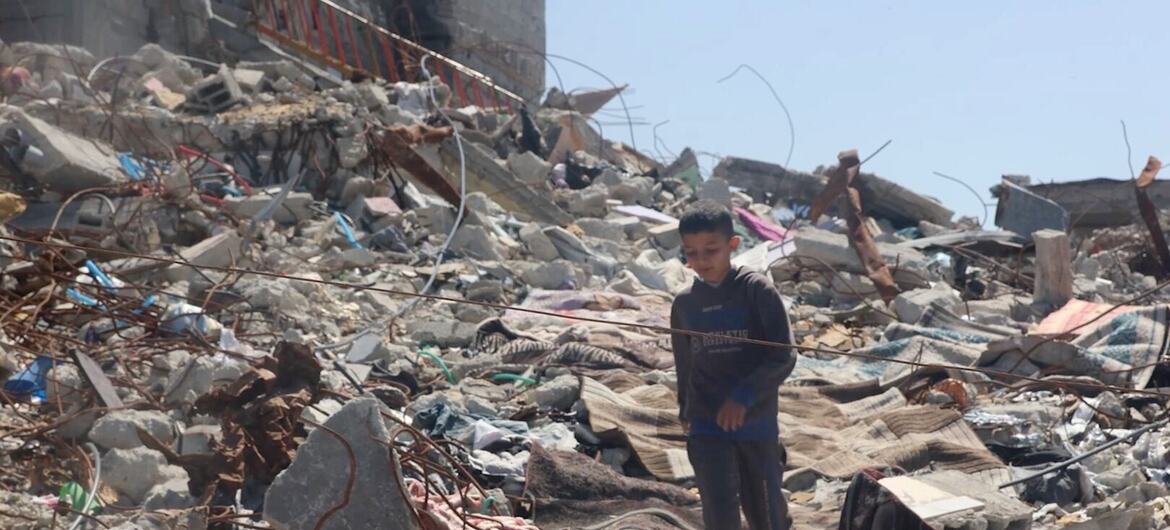
The extreme, brutal and patently ruthless Israeli military response in Gaza raises questions of inescapable gravity. Entire neighbourhoods have been destroyed. Hospitals, schools, homes and essential infrastructure have been razed. Hundreds of thousands of people have been displaced, repeatedly in many cases. The civilian death toll has been immense (and almost certainly understated), and the population has endured conditions of hunger, disease, trauma and profound insecurity.
One might ask what precisely is the strategic or moral goal in reducing an already impoverished civilian society to such misery. One might ask indeed, but the answer is simple and obvious:

The argument that Hamas operates among civilians is relevant to the conduct of military operations, but it does not magically transform every civilian into a legitimate target. International humanitarian law is not an optional extra to be discarded whenever military leaders find it inconvenient.
Nor does the right of self-defence confer an unlimited licence to inflict suffering, or, you know, snipe children for sport.
There is something particularly disturbing about the casual invocation of security as a justification for almost anything. History is littered with governments that have committed appalling acts while insisting that extraordinary circumstances required extraordinary measures. The perpetrators of such actions rarely describe themselves as villains. They invariably believe they are defending something sacred, but there is nothing sacred here. Judaism has no special status. It’s as baseless and delusional as any religion on the face of the Earth, and any cultural or political edifice that arises from it ought be subject to suspicion at a minimum, and absolute disregard at most.
This is precisely why civilised societies establish rules, restraints and legal obligations in the first place, and express those things consistently, without regard for ethnic, cultural or political difference. Principles are not principles if they are expressed arbitrarily or out of self-interest.
Israel also has a rather uncomfortable problem with its democratic credentials. It proudly describes itself as the Middle East’s only democracy, and in many respects it has genuine democratic institutions, a lively press, competitive elections and a vigorous political culture.
But democracy is not simply a matter of allowing citizens to put a ballot paper in a box every few years.
What of the millions of Palestinians living under Israeli military occupation, subject to Israeli (military) authority but without the same political or legal rights enjoyed by Israeli citizens? What of the continuing expansion of settlements, the restrictions on Palestinian movement and the profoundly unequal realities of life in the occupied territories?
A country cannot indefinitely exercise effective control over another population while pretending that the democratic responsibilities associated with that control simply disappear.
There is also the matter of language. When political leaders speak about an entire civilian population in dehumanising terms, describing people collectively as enemies or implying that their suffering is of little consequence, or that their children ought be considered future terrorists and therefore the moral equivalent of a “combatant”, the consequences can be, and demonstrably are, chilling.
Words matter. They establish the moral atmosphere in which actions are contemplated and justified. A society that becomes accustomed to viewing the suffering of another population as an acceptable inconvenience is a society in danger of losing something fundamental. This is where Israel arguably is right now.
I mean, FFS, you don’t get to establish a system of river cruises from which you can view the bombing of declared enemies as a form of entertainment and for a moment think you can nevertheless be reasonably considered to be “civilised”. Fuck that to hell and back. It’s beyond depraved.
Naturally, none of this excuses Hamas. Its atrocities, its authoritarianism and its treatment of hostages deserve unequivocal condemnation. But the barbarity of one side does not provide a moral blank cheque to the other. Civilisation is not a competition in which the side committing the greater number of atrocities wins the right to describe itself as decent and respectable.
And that brings us back to the original question. Can Israel be considered a civilised nation?
If civilisation is measured by scientific achievement, economic sophistication and technological advancement, then unquestionably yes. But if it is measured by respect for human dignity, equality, restraint in the exercise of power and adherence to international law, the answer becomes considerably less obvious. For me it’s unequivocally No.
A nation can possess the most sophisticated weapons in the world and still demonstrate a profound deficiency in moral judgement (sound familiar?). It can hold democratic elections and yet tolerate systems of profound inequality (also sound familiar?). It can speak endlessly about its own security while appearing remarkably indifferent to the security, freedom and survival of those living under its control. It can’t evince a cultural and political agenda (Zionism) that makes the decent and reasonable treatment of its neighbours and persons under its control impossible and just turn around and pretend it’s all hunky dory.
Civilisation is not something a country inherits, purchases or awards itself. It is something it must continually demonstrate through its actions and political rhetoric. On both those criteria, Israel is, and has long failed miserably.
And the ultimate test is not how a nation treats its friends, its citizens or those who share its religion and national identity. It is how it treats the powerless, the dispossessed and those whose lives it has the power to destroy.
To paraphrase Nelson Mandela, “There can be no keener revelation of a society’s soul than the way in which it treats its children, or the children of those over whom it wields supreme power.”
On those tests, Israel’s recent record is absent any kind of virtue or capacity to be rehabilitated.
It is time Western governments stopped confusing military strength with moral authority, and stopped treating criticism of an allied government as though it were an act of diplomatic treason.
Israel has every right to exist, every right to protect its citizens and every right to live in peace and security. But it has no more right than any other country to disregard the humanity of its neighbours, whose territory, in this case, it claims to own.
And if the word civilisation is to retain even a shred of meaning, Israel must be judged by precisely the same standards as the rest of us.
No special exemptions. No historical get-out-of-jail-free card. No diplomatic bullshit.
The distinction between Israel and its people
Caveat alert: It would be intellectually dishonest and morally unacceptable to equate the actions of the Israeli government with the character of every Israeli citizen, or to confuse criticism of the Israeli state with hostility towards Jewish people more generally (but, hey, tell that to the average Zionist).
Israel contains a diverse population, including people who strongly oppose their government’s policies. Israeli journalists, academics, human rights advocates, political activists and ordinary citizens have protested against occupation, settlement expansion and the conduct of the war in Gaza.
There is also a long tradition within Jewish intellectual and religious thought of defending human dignity, justice and compassion, and of opposing the Zionist project. I acknowledge this reality and those people and wish them well in their efforts.
Thanks for reading. All the best to you.


